
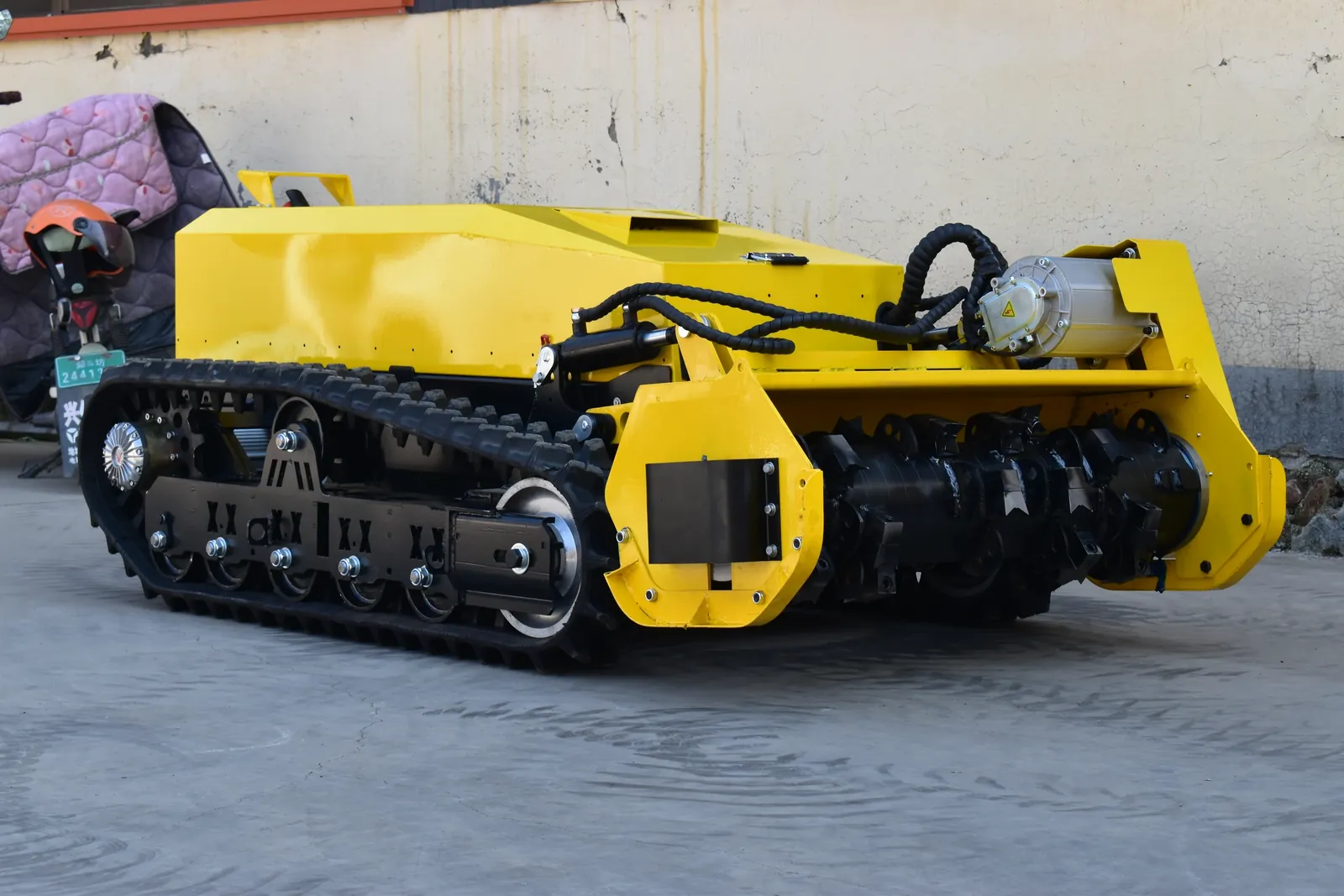
Steep banks are where mowing gets expensive, slow and genuinely dangerous. Moving the operator off the machine is the most direct fix.
The problem with ride-on mowing on a slope
The safety guidance is fairly blunt. US workplace safety guidance advises against mowing slopes steeper than about 15 degrees when no other information is available, and university extension guidance notes that ride-on mowers can slide or roll over on gradients above roughly 27 percent.
Rollover is the risk that ends careers. Add loss of traction, sudden softening of the ground after rain, and the debris thrown by a cutting head on a slope, and the case for keeping a person off the machine becomes obvious.
What remote control changes
On a remote-operated tracked machine there is no cab, no seat and no controls on the unit itself. The operator stands clear of the cutting area and the machine’s tip path, working from a handheld controller instead.
That single change removes the person from the rollover scenario. It also means the same operator can work ground that a ride-on simply should not be taken onto — embankments, batters, orchard rows, drainage channels and firebreaks.
Why tracks rather than wheels
- Contact area. Tracks spread weight over a longer, wider footprint, so the machine sinks less on soft or uneven ground.
- Grip. More contact with the surface means less slipping when climbing or traversing a bank.
- Obstacle handling. An angled front to the track frame helps the machine climb over roots, stones and debris instead of stalling against them.
What machine manufacturers claim about slope
Remote-controlled slope mowers are commonly marketed as handling gradients up to roughly 50 to 60 degrees. Treat that number as a headline figure, not a working instruction: real capability depends on ground condition, moisture, load, cutting height and the direction you approach the slope.
Operator checklist before you start the slope
- Walk the bank first and mark holes, stumps and drop-offs.
- Check the documented slope limit for your machine and your configuration.
- Work up and down the fall line before attempting traversing.
- Keep the controller line-of-sight and stay clear of the discharge side.
- Re-check the ground after rain — traction changes fastest when it is wet.
Remote control does not remove the need for judgement. It removes the operator from the most dangerous place to be when that judgement turns out to be wrong.